


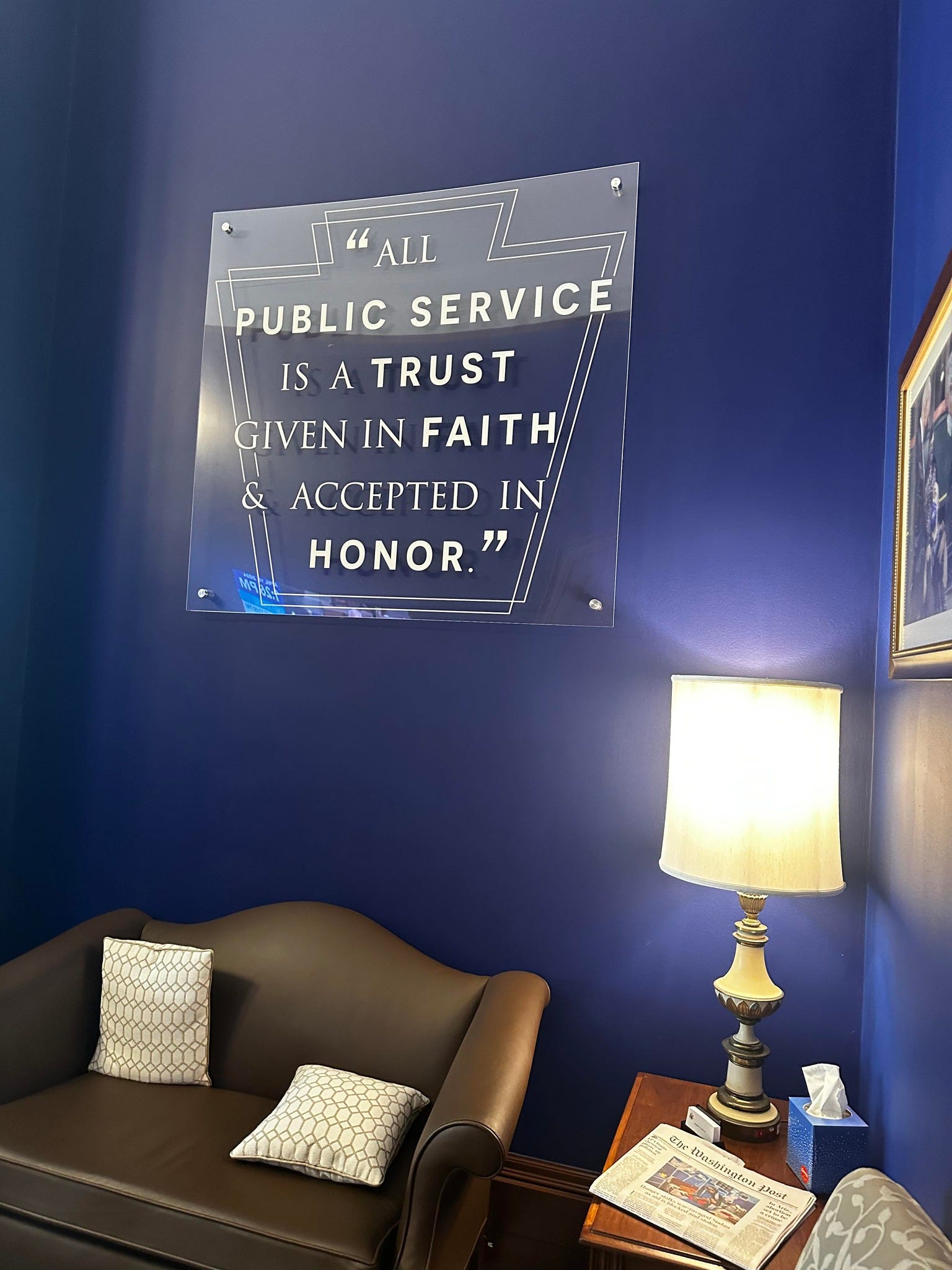
I took this photo years ago in Bob Casey Jr.’s office, during a trip to Washington, D.C. with the National Parents Union.
I was there as a parent.
Not as a donor.
Not as an insider.
Just a father who believed that showing up still mattered.
The quote on the wall stopped me cold:
“All public service is a trust given in faith and accepted in honor.”
It’s a powerful sentence.
Carefully framed.
Placed where visitors can’t miss it.
At the time, it felt reassuring—like a shared understanding between those who serve and those they’re meant to serve.
But over the years, that quote has stayed with me for a different reason.
It haunts me.
Not because it’s wrong.
But because I’ve watched how easy it is for that trust to be treated as conditional.
Public service is a trust.
It’s not a favor.
It’s not transactional.
And it’s not meant to be shaped by catering to a select few while the many quietly carry the consequences.
That trust is given in faith—by parents who assume lawmakers will protect children even when it’s politically uncomfortable.
By families who don’t have lobbyists, donors, or influence—but believe the system will still hear them.
By people who show up once, twice, maybe only once, trusting that their voice mattered even if it wasn’t loud.
Honor isn’t the quote on the wall.
Honor shows up in choices.
In who gets listened to—and who doesn’t.
In whether access is real, or just symbolic.
What’s hardest to watch now isn’t disagreement.
It’s selective attention.
When lawmakers begin catering to the few instead of stewarding responsibility to the many, trust erodes.
Quietly.
Patiently.
Until one day, it’s gone.
Parents notice.
Families notice.
They start asking questions—not out of anger, but awareness.
Who is being heard?
Who is being ignored?
And why does it feel like faith is always required from families—but honor is optional for those in power?
The most dangerous thing in public service isn’t opposition.
It’s comfort.
Comfort makes it easier to forget who placed that trust in you.
Easier to mistake access for accountability.
Easier to believe that silence means satisfaction.
It doesn’t.
Silence often means people have stopped believing they’ll be heard.
That quote still lives in my mind.
Not as decoration.
As a standard.
One that parents are watching closely—across parties, across offices, across years—to see who still lives up to it.
Because public service isn’t about the few.
It’s about the many.
And stewardship, once broken, is very hard to earn back.